
Object Record
Images
Metadata
Catalog Number |
2023.012.021 |
Object Name |
Painting |
Description |
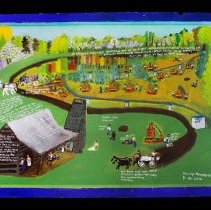
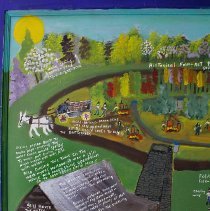
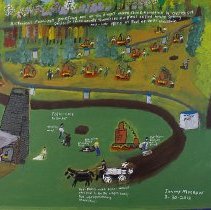
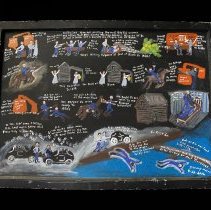
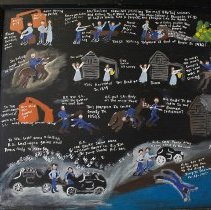
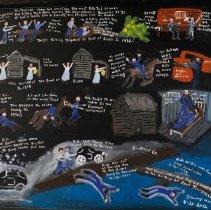
This double-sided painting was created by the Reverend Jimmy Morrow of Cocke County, Tennessee. The painting was painted on wood that served as a portion of a door in the first home that Reverend Morrow and his wife, Pam Morrow, shared together after they married. Both sides of the painting depict Morrow's recollections of moonshining history in Cocke County, Tennessee. Side one of the painting is dated 3-30-2012. This painting depicts multiple moonshine operations taking place amidst a verdant, forested setting. There are several portions of handpainted text in white that narrate the events of the painting throughout. The primary caption of the painting is located in the upper right quadrant and reads: "Historical Folk-Art Painting One of the Bigget Moon Shine Operation 14 Copper Pot Stills-In Cocke County Tennessee at a Place Called White Spring Mid-Late 1800.s at Foot of Halls Mountain." 13 of the 14 stills are illustrated with figures working near them below the caption. The uppermost border of the scene features a light blue sky with a yellow sun in the left corner. There is a treeline filled with green, purple, and white trees below, with a small white fence and a white cross on the far left. This detail is labelled "White Spring Grave-Yard" in white paint. Below the graveyard and to the left of the thirteen stills there is a white horse leading a wagon. There is one driver in the wagon and a few figures standing at the back of the wagon unloading brown barrels or cases. This detail is labelled "1000.s-gallons-moonshine was case up and haul out by wagon loads to sale to the bootleggers" in white paint. The lower left quadrant of the painting depicts a brown cabin with a large smokestack and several figures out on the front porch. Two figures are standing in the doorway, three figures are surrounding a table, and one figure is standing near the smokestack, where there is a black pot hanging over an open fire. There are three sections of handpainted text that accompany this cabin scene. The first text section is in the green grass just above and behind the cabin. It reads: "Useing poplar bark to make pipe-pipeing the water from White Spring to water pot during the night water pot was fill with water. Also during this time in the West Myers Hollow it was a still house and moonshine operation in to late 1800.s early 1900.s." The second text section is positioned as two paragraphs along the roof of the cabin. It reads: "The women cook-eggs-ham-wheat-bread-grits-oatmeal-coffee-red eye gravey-for the morning meal- Beans-potatoes, cornmeal gravey-fry bear meat-wild hog-deer meat. corn meal-plenty of hot coffee for the evening meal." The third text section is positioned along the side of the cabin. It reads: "Still House the wifes cook meals for their husbands while they made moonshine at night-early in the morning the moonshiner would sleep during the day." The lower right quadrant of the painting illustrates some of the processes involved in making the moonshine. A long dirt road curves and connects upper portions of the painting to the lower right quadrant. Morrow labelled the painting as "Folk-Lore" and "Folk-Art" in white paint in the center, just below a stretch of the dirt road. There are four miniature scenes in this final quadrant that show different moonshining tasks. The first is captioned "choping wood" and shows a masculine figure chopping wood near a wood pile. The second is captioned "stacking cases of moon shine" and shows a feminine figure with blonde hair and a blue dress adding a case to a growing stack of cases. The third is captioned "bottleing-caseing moon shine" and shows a masculine figure taking the product from a "copper pot moon shine still" and putting it into white bottles with black X's on them before loading the bottles into a brown case. The fourth is captioned "rye-barley-meal-sugar-wheat was haul in by the wagon loads for useing makeing moonshine" and shows two dark horses pulling a black and white wagon with white packages in the back. A driver in black sits atop the wagon and two masculine figures with white shirts stand behind the wagon, ready to unload the product. Side one is bordered with a dark cobalt blue paint. Side two of the painting is dated 4-29-2012. This painting features a much darker color palette than side one and depicts several scenes related to moonshine operations taking place in East Tennessee. There are several portions of handpainted text in white that narrate the events of the painting throughout. The primary caption of the painting is located in the upper center and reads: "Historical Folk-Art painting the most brutal crimes and killing took place among the moonshiners Proverbs 23:32 at last it biteth like a serpent, and stingeth like an adder." There are essentially four horizontal strips that each tell a different story related to moonshining in East Tennessee, starting immediately below the primary caption. The first story is comprised of four scenes. The first scene shows a masculine figure on the left side of a still, captioned "Frank McGahn bottleling moon shine." A masculine figure is shown speaking to a feminine figure on the right side of the same still, captioned "Omas talking to Festus." The second scene shows a masculine figure pointing a gun at two other masculine figures sitting on a log, captioned "Frank McGahn shot and kill S.B.-M.W. at the resting log." The third scene shows a masculine figure dragging two bodies beneath a tree, captioned "Frank drag the bodys S.B.-M.W. to a falling poplar tree that up rooted the ground throw their bodys in the hole cover them up." The fourth scene shows two figures talking inside a jail cell, captioned "Drank Frank told about the killings under cover lawman got Frank McGahn." Morrow wrote beneath this story: "These killing took place at Bend of River in 1930.s." The second story is comprised of three scenes. The first scene shows a masculine figure riding a brown horse, captioned "Joe Datson made raid on the moon shiners." The second scene shows two gray cabins, each with two feminine figures outside waving their arms or holding oil lamps, captioned "the wife lite their oil lamps to warn the moon shiners the law was a coming." The third scene shows the original figure on horseback being shot by another masculine figure hiding behind a copper pot moonshine still, captioned "Joe Datson was shot and kill by moon shiner." Morrow wrote beneath this story: "This happen at the Bend of River in 1899." The third story is comprised of four scenes. The first scene shows a moon shine still copper pot, captioned "In the Wolf-Creek Settlement while A.T.-S.L. was making moon shine." The second scene shows one masculine figure hitting another masculine figure with the butt of his gun, captioned "A.T. kill S.L. with the butt of his shot gun." The third scene shows one masculine figure guiding a brown horse with a dead body strewn across its back, captioned "A.T. put S.L. body on the mule took his body to his cabin in the Boomer settlement." The fourth scene shows a cabin on the left and a scene inside the cabin on the right which shows a masculine figure killing another masculine figure that is laying down in his bed, captioned "A.T. told the law that he kill S.L. at his house." Morrow wrote beneath this story: "This happen in Cocke County TN. 1950.s." The fourth story is comprised of three scenes. The first scene shows a figure with a black vehicle jump-starting another black vehicle with a figure standing nearby as snow falls, captioned "In Dec. light snow a falling R.G. last moon shine haul from Cosby to Knox Co. R.G. car broke down near Wilsoville Cocke Co. Big Jim jump started R.G. car." The second scene shows two figures chasing after a black vehicle while a third figure dives into a body of water, captioned "R.G. car broke after a long chase by the law. R.G. got out of the car ran to the river jump in drownd 12-23-1955." The third scene shows a figure drowning in a body of water, captioned "Body of R.G. was found lodge against a tree 2-12-1956 the longes man hunt for a x moonshiner in the history of East Tennessee." Morrow wrote above this story: "In Knox Co." Side two is bordered with dark black paint, and the background of all of the scenes is also black, contrasting starkly with the vivid colors used for side one. Jimmy Morrow was born March 6, 1955 in Raven Branch, a population area in rural Del Rio, Tennessee. His father, Albert Morrow, is remembered as a very devout man who raised his seven children in the church, and young Jimmy Morrow began preaching there when he was six years old, soon after he received his first vision. Throughout his career, in which the Rev. Morrow is remembered as the founder and pastor of the Edwina Church of God in Jesus Christ's Name, Morrow also preached at churches in Tennessee, Alabama, Georgia, South Carolina, and Kentucky. Alongside his work as a spiritual leader, Morrow compiled genealogies, collected photos, and documented local histories by hand, amassing one of the largest collections of information on Appalachian religious serpent handling in the world. At the time of his passing on January 24, 2023, the Rev. Morrow had become known internationally for his strong faith and religious practices, as well as for his art, and has been featured in documentary films, book publications, podcasts, and numerous articles. Reverend Jimmy Morrow is remembered as a kind man who never met a stranger, a wise community member who generously shared his knowledge and cared for his neighbors, and an impassioned self-taught artist who painted, made kudzu baskets, constructed dolls and stuffed figures, and built snake boxes to transport his wild-caught serpents. In the spring of 2023, Dr. Rick Cary, Professor Emeritus at Mars Hill University, contacted the Reece Museum to gauge our interest in helping to preserve and share Jimmy Morrow's artistic legacy following his sudden passing. Having known the Rev. Morrow for a number of years, Dr. Cary has been instrumental in the Reece Museum's ability to collect and document the artworks, memories, and stories that keep Morrow's spirit and his important connection to Appalachia alive. In the years following our initial meeting, Reece Museum staff have had the privilege of connecting with Mrs. Pamela Morrow, who was married to Jimmy for 49 years. The wounds of Pam's loss are still fresh, but she has been gracious enough to share stories about her community and her observations of the Rev. Morrow's art-making practice. Pam recalls that Jimmy created his paintings from spiritual visions and messages from God. He would not paint while seated or standing-he only painted on his knees, on the concrete porch of his home in Del Rio, Tennessee. She describes his paintings as "gifts of the Spirit" and fondly remembers, "Jimmy painted what God showed him." Over the course of four or five visits, Mrs. Morrow and Dr. Cary guided us through the Edwina Church of God in Jesus Christ's Name, which the Morrows founded in 1993. Albert Morrow, Jimmy's father, bought the land from Pamela's family and donated it to the church. The Morrows and the church members built the church and the adjacent cabin, which held an amassed archive of the Rev. Morrow's paintings, baskets, and dolls. The vast majority of Morrow's visionary artworks that we viewed featured depictions of animals, mountainous landscapes, or collected histories related to the Cocke County area. |
Date |
2012 |
Artist |
Rev. Jimmy Morrow |
Collection |
Sacred and/or Religious Artifacts Collection |
Place of Origin |
USA/Tennessee/Cocke County/Del Rio |
Material |
acrylic paints on salvaged lumber |
Subjects |
sacred Appalachia folk art |
Search Terms |
sacred Appalachia folk art |