
Object Record
Images
Metadata
Catalog Number |
2023.012.020 |
Object Name |
Banner |
Description |
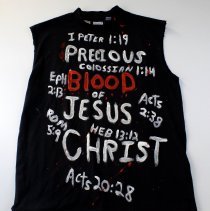
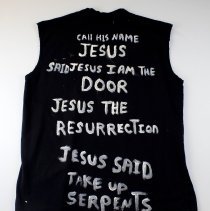
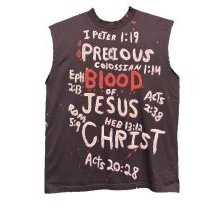
This banner was painted by the Reverend Jimmy Morrow of Cocke County, Tennessee, for his friend: documentarian, artist, and scholar Dr. Rick Cary. Dr. Cary donated this banner to the Reece Museum's collection of Jimmy Morrow artworks during the museum's Community History Harvest on Saturday, November 15, 2025. Jimmy Morrow wore banners such as this one during his religious practices as a Signs Follower and serpent handler. Reverend Morrow's banners were typically made of a standard black t-shirt with the sleeves cut off. Reverend Morrow would then use paints (typically in white) to inscribe Bible verses and/or religious phrases that aligned with his beliefs as a Signs Follower. Dr. Rick Cary, the donor of this banner, recalls that he once asked Jimmy if he could have a banner, to which Jimmy replied, "I could make you one." Reverend Morrow made this banner specifically for Dr. Cary, likely in the late 2000s or early 2010s, when Dr. Cary was documenting Jimmy's services at his church, the Edwina Church of God in Jesus' Name in Newport (Edwina), Tennessee. The front of this banner has a central message that reads: "Precious Blood of Jesus Christ." The message is predominantly painted in white, with "Blood" painted in a contrasting red. Interspersed around this central message are references to Biblical scripture that are painted white and in a slightly smaller font size. The verses referenced include 1 Peter 1:19, Colossian 1:14, Eph. 2:13, Acts 2:38, Rom. 5:9, Heb. 13:12, and Acts 20:28. There are speckles of red and white paint across the surface of the front of the banner, sometimes bleeding into the painted text. The back of this banner has more text, but this time in solely white paint and without the additional speckled details. The white painted text reads: "Call His Name / Jesus / Said Jesus I Am The / Door / Jesus The / Resurrection / Jesus Said / Take Up / Serpents." Jimmy Morrow was born March 6, 1955 in Raven Branch, a population area in rural Del Rio, Tennessee. His father, Albert Morrow, is remembered as a very devout man who raised his seven children in the church, and young Jimmy Morrow began preaching there when he was six years old, soon after he received his first vision. Throughout his career, in which the Rev. Morrow is remembered as the founder and pastor of the Edwina Church of God in Jesus Christ's Name, Morrow also preached at churches in Tennessee, Alabama, Georgia, South Carolina, and Kentucky. Alongside his work as a spiritual leader, Morrow compiled genealogies, collected photos, and documented local histories by hand, amassing one of the largest collections of information on Appalachian religious serpent handling in the world. At the time of his passing on January 24, 2023, the Rev. Morrow had become known internationally for his strong faith and religious practices, as well as for his art, and has been featured in documentary films, book publications, podcasts, and numerous articles. Reverend Jimmy Morrow is remembered as a kind man who never met a stranger, a wise community member who generously shared his knowledge and cared for his neighbors, and an impassioned self-taught artist who painted, made kudzu baskets, constructed dolls and stuffed figures, and built snake boxes to transport his wild-caught serpents. In the spring of 2023, Dr. Rick Cary, Professor Emeritus at Mars Hill University, contacted the Reece Museum to gauge our interest in helping to preserve and share Jimmy Morrow's artistic legacy following his sudden passing. Having known the Rev. Morrow for a number of years, Dr. Cary has been instrumental in the Reece Museum's ability to collect and document the artworks, memories, and stories that keep Morrow's spirit and his important connection to Appalachia alive. In the years following our initial meeting, Reece Museum staff have had the privilege of connecting with Mrs. Pamela Morrow, who was married to Jimmy for 49 years. The wounds of Pam's loss are still fresh, but she has been gracious enough to share stories about her community and her observations of the Rev. Morrow's art-making practice. Pam recalls that Jimmy created his paintings from spiritual visions and messages from God. He would not paint while seated or standing-he only painted on his knees, on the concrete porch of his home in Del Rio, Tennessee. She describes his paintings as "gifts of the Spirit" and fondly remembers, "Jimmy painted what God showed him." Over the course of four or five visits, Mrs. Morrow and Dr. Cary guided us through the Edwina Church of God in Jesus Christ's Name, which the Morrows founded in 1993. Albert Morrow, Jimmy's father, bought the land from Pamela's family and donated it to the church. The Morrows and the church members built the church and the adjacent cabin, which held an amassed archive of the Rev. Morrow's paintings, baskets, and dolls. The vast majority of Morrow's visionary artworks that we viewed featured depictions of animals, mountainous landscapes, or collected histories related to the Cocke County area. Banners like this one are sometimes referenced in Morrow's art, particular in his references to serpent handling as a religious practice. Our permanent collection currently features a soft sculpture or doll made by Morrow that features a banner and might be a self-referential nod to the artist, or could possibly be intended to represent a historic figure in the serpent handling community (2023.012.012). The Reece Museum also features two paintings by Morrow that reference historic figures handling serpents while wearing banners (2023.012.010 and 2023.012.011). Our permanent collection also features a portrait of Reverend Jimmy Morrow by his friend: musician, artist, and scholar Abe Partridge (2025.012.001). |
Date |
c. 2007 |
Artist |
Rev. Jimmy Morrow |
Collection |
Sacred and/or Religious Artifacts Collection |
Place of Origin |
USA/Tennessee/Cocke County/Del Rio |
Material |
acrylic paints on polyester and cotton shirt |
Subjects |
sacred Appalachia folk art |
Search Terms |
sacred Appalachia folk art |