
Object Record
Images
Additional Images [12]
Metadata
Catalog Number |
1988.005.002 |
Object Name |
Quilt |
Description |
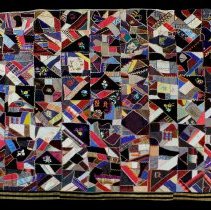
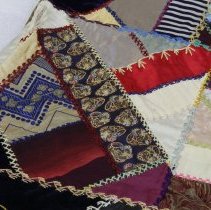
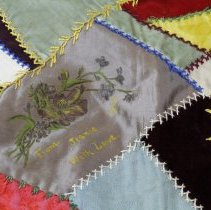
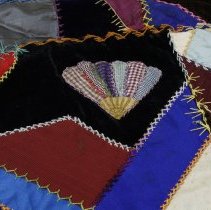
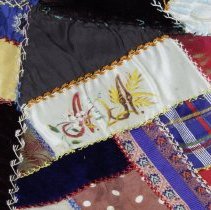
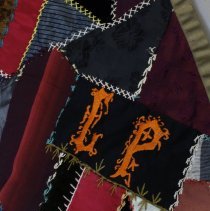
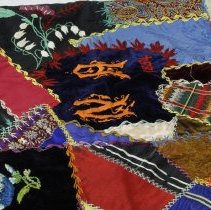
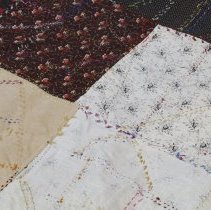
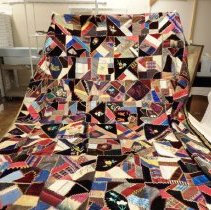
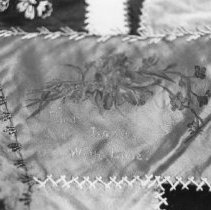
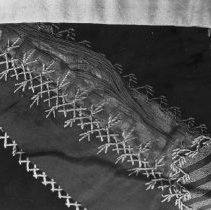
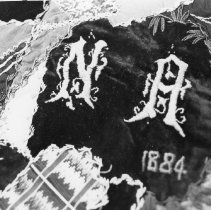
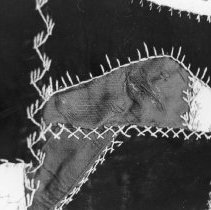
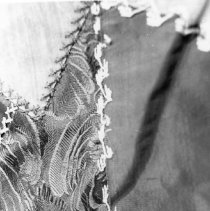
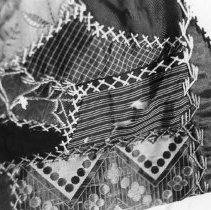
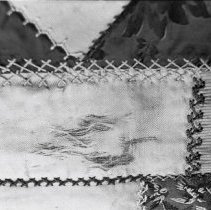
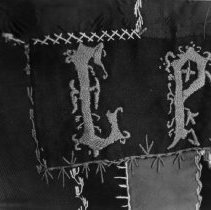
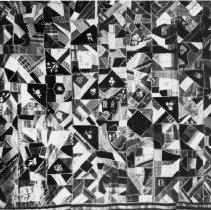
This is a 'crazy quilt' with irregularly sized blocks assembled in rows, much like the stacked bars set seen in rural Southern quilts. There are eight "bars" or "rows" ranging from 7 to 17" wide. There is a bottom border of 3." The quilt features motifs including flowers, a crescent moon, butterflies, hand fans, and cherries. Some motifs are embroidered while others are painted directly onto the fabric. The back of the quilt is made of printed cotton squares. In many cases the embroidery is visible on the back meaning the maker embroidered the squares after the backing was added. The initials "N.A." (for Nanie Aker) with "1884" and E.P. or L.P. (unknown) appear both embroidered and painted on the quilt. The quilt also has "From Jeanie With Love, 1884" painted on the silk. In addition to having many stitch patterns, crazy quilts usually have many embroidered motifs. Typical techniques include outline stitching, Kensington stitch (which carefully blends colors of embroidery thread to create a natural appearance), satin stitch, stump work, couching, ruching and many more. This extravagant display was time consuming and was an opportunity to display an education which included fine stitchery among other subjects. The fad for this type of quilt was wide spread, prompting silk companies to sell scraps by the pound, pre-stitched embroideries which could be applied to the quilt, and patterns for embroidery. The same redwork patterns so popular in the period were also adapted for crazy quilts. Many jokes were made about cutting off the neckties to incorporate into quilts. People went so far as to have 'crazy' parties where unmatched clothing was worn, and the subject of the conversation was changed every time a bell was rung. 'Crazy' quilts and other forms of show quilts were not made for use or to provide warmth. They were most commonly displayed draped in the parlor or reception room, gracing a chaise or the piano. The fad, which had originated possibly as a response to cheaply produced silk and the centennial exhibition of 1876 where asymmetrical Japanese art was displayed to great admiration, was prompted by articles in ladies' magazines. Those same magazines deplored the style in the 1890s and it came to an abrupt stop. The 'crazy' style persisted in the Appalachian South until the 1920s, frequently appearing in wool rather than silk, with wool embroidery rather than silk and cotton. |
Date |
1884 |
Artist |
Narnie Aker |
Dimensions |
W-80.5 L-71.5 inches |
Collection |
Historic Textile Collection |
Place of Origin |
USA |
Material |
fabric, silk, velvet, cotton |
Makers mark |
The letter "E" appears inside a painted wreath. . There is an inscription "From Jeanie with love 1884". The initials "LP" "LM" and "AA" are embroidered on different patches. Workmanship: Good. Embroidery is Very Good. |
Subjects |
local history costume, clothing, and textiles |
Made |
Narnie Aker |